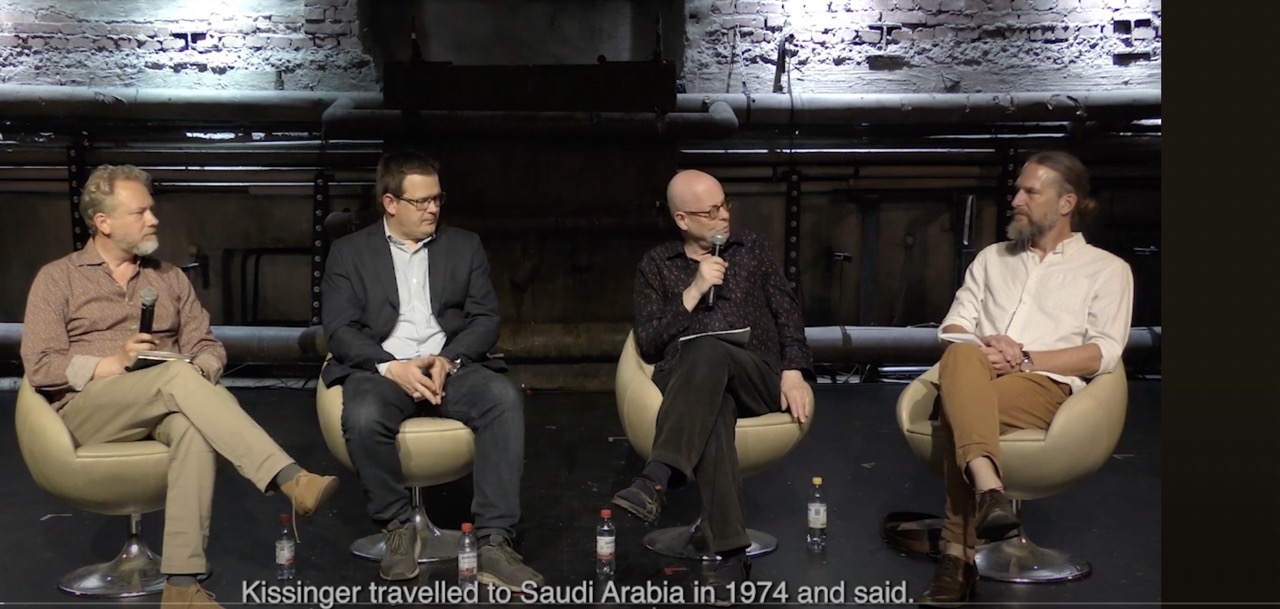
You can now listen to the important and enlightening lectures and conversations between professors Ola Tunander of the Peace Research Institute Oslo and Glenn Diesen of the University of South-Eastern Norway, which took place on 28 May at 7 pm at Hornsgatan 92, T-Zinkensdamm in Stockholm.
During the event they lectured and answered questions about the global crisis, with a focus on the war in Ukraine. The event was organised by Dissidentklubben, FiB Kulturfront branch 5 and Riksföreningen Nej till Nato. The venue was full, and the audience included MoD’s party leader Andreas Sidkvist.
Summary and introduction of the speakers:
Introduction of Ola Tunander and Glenn Diesen:
Ola Tunander is a prominent Norwegian-Swedish researcher in international politics and security studies. He has worked at the Peace Research Institute Oslo (PRIO) and has had a long academic career focused on geopolitics, military strategy and security policy. Tunander has published a large number of books and articles that shed light on complex power relations between great powers, particularly regarding the USA and its role in global conflicts.
Glenn Diesen is a Norwegian professor and researcher in international relations and geopolitics, with a particular focus on the role of Russia and China in the global order. He teaches at the University of South-Eastern Norway and has published several works analysing Western dominance and the challenges it faces from other great powers. Diesen is known for his criticism of the influence of Western liberalism on international politics and for his insights into the relationship between economics and geopolitics.
Geopolitical context and balance of power:
Tunander and Diesen argue that the Ukraine crisis is not just a regional conflict but part of a larger global struggle for dominance. They see it as an example of how great powers, especially the USA, try to retain their hegemony by countering challengers such as Russia.
Criticism of Western narratives:
A central point in their discussion is the criticism of Western narratives that are often presented as objective or democratic but which, according to them, may be manipulated to support specific geopolitical agendas. This includes how concepts such as democracy and genocide are used in political discourse to justify interventions and other power-political measures.
Manipulation of science and ideology:
They emphasise that science and academic discourse have become subject to manipulation, where truth and facts can be distorted to serve specific ideological and political purposes. This leads to an erosion of trust in science and a shift towards a more narrative-driven way of seeing the world.
The importance of understanding underlying power structures:
Tunander and Diesen highlight the importance of understanding the underlying power structures that drive international politics. They argue that without this understanding one risks becoming a tool for the forces that use narrative and ideology to achieve their goals.
Reflection on Western dominance:
One conclusion drawn is that Western countries, and especially the USA, use their dominance in media and academic research to shape global opinion and political decisions. This is often done under the pretext of promoting democracy and human rights, but in reality it may be about maintaining a global order that benefits the West.
In summary, Tunander and Diesen stress that it is crucial to critically examine the narratives and ideologies presented as truths, especially in connection with international conflicts such as the Ukraine crisis. They call for a deeper understanding of the geopolitical and power-political dynamics that shape the world today.